


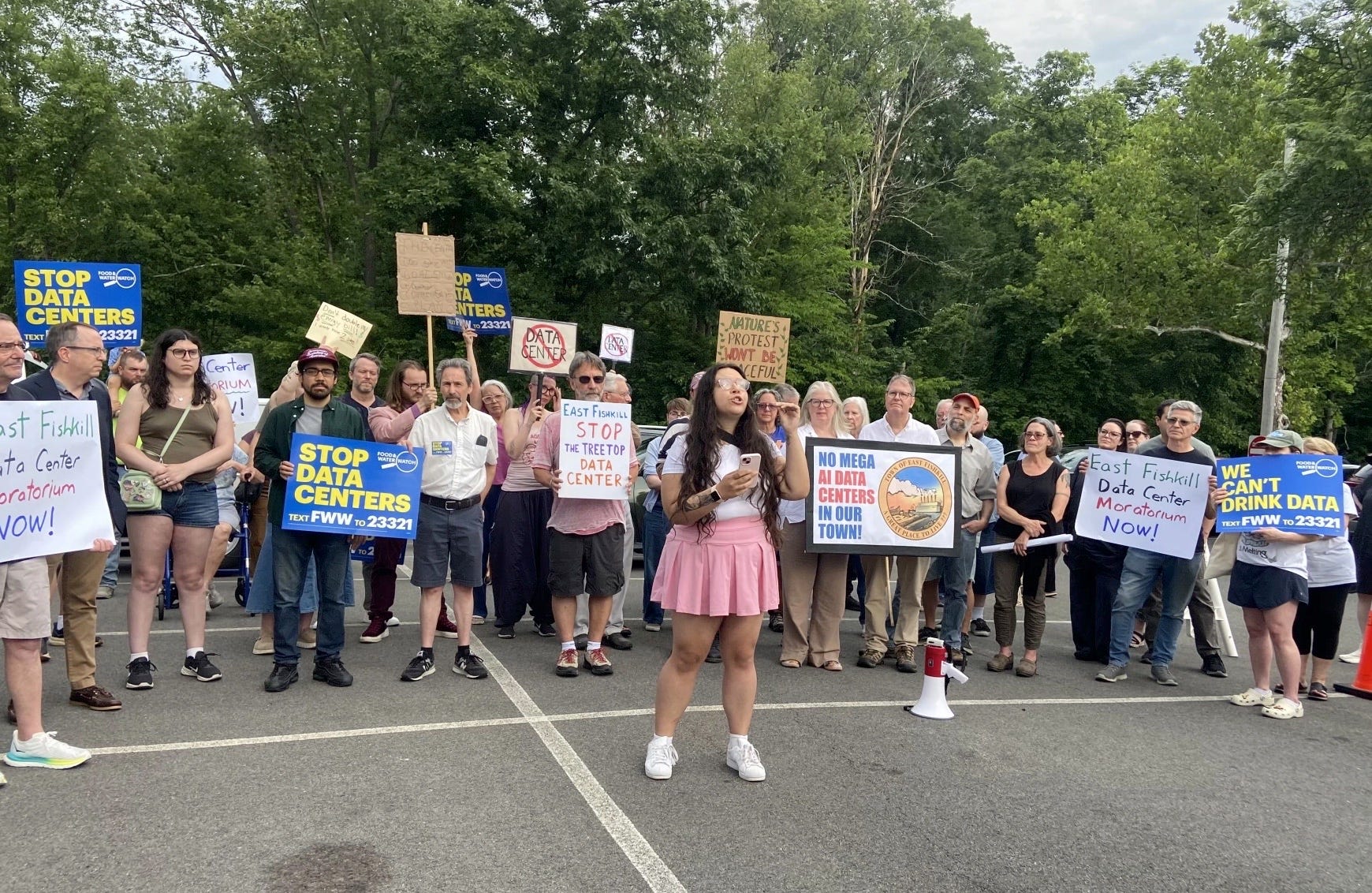
The legacy media has woken up to the backlash against data centers. Unfortunately, much of the analysis misses the mark. Last month, a conservative writer published a piece in the New York Post in which he claimed that “The effective voices against data centers, after all, are the same Luddites who’ve spread environmental apocalypticism to stop modernization projects such as pipelines and power plants and fracking.”
A few days later, the New York Times ran an op-ed that was headlined, “The Environmental Case Against Data Centers Is Misguided,” in which the writer claimed to “empathize with the environmental opposition to data center construction, but the arguments are shakier than they seem.” (The writer completely ignored the serious problem of noise pollution, among other things.)
While pundits would like to dismiss the opposition, the numbers don’t lie. A poll published last week by Fox News found that “by a 40-point margin, voters opposed data centers in their area to support artificial intelligence.”

As I have explained in my previous coverage of this issue — see here, here, here, here, and here — as well as in our short documentary, “The Data Center Backlash,” the opposition to data centers is similar to what I have seen in my coverage of the opposition to Big Solar and Big Wind projects. As I explained in May, in “Top 10 Reasons Why Communities Are Fighting Data Centers,” the simple truth is that people “all across the US and around the world are fighting data centers because these projects are not providing sufficient value to their communities.”
That fact helps explain why last week, Willie Nelson declared on Instagram that “The last thing we need is a loud, water-thieving, light-polluting, data center anywhere near our town.” Willie’s comments provide further proof that what we are seeing is a cultural backlash against Big Tech. That’s why I’ve been covering the issue so closely. Energy policy and land-use policy are two sides of the same coin. Energy policy (data centers are an example of energy policy) determines land-use policy and vice versa. Further, the backlash against Big Tech reflects deep anger in the American electorate. As one Democratic strategist told the Wall Street Journal last week in an article about the rise of the far-left socialists, “Voters are pissed off.”
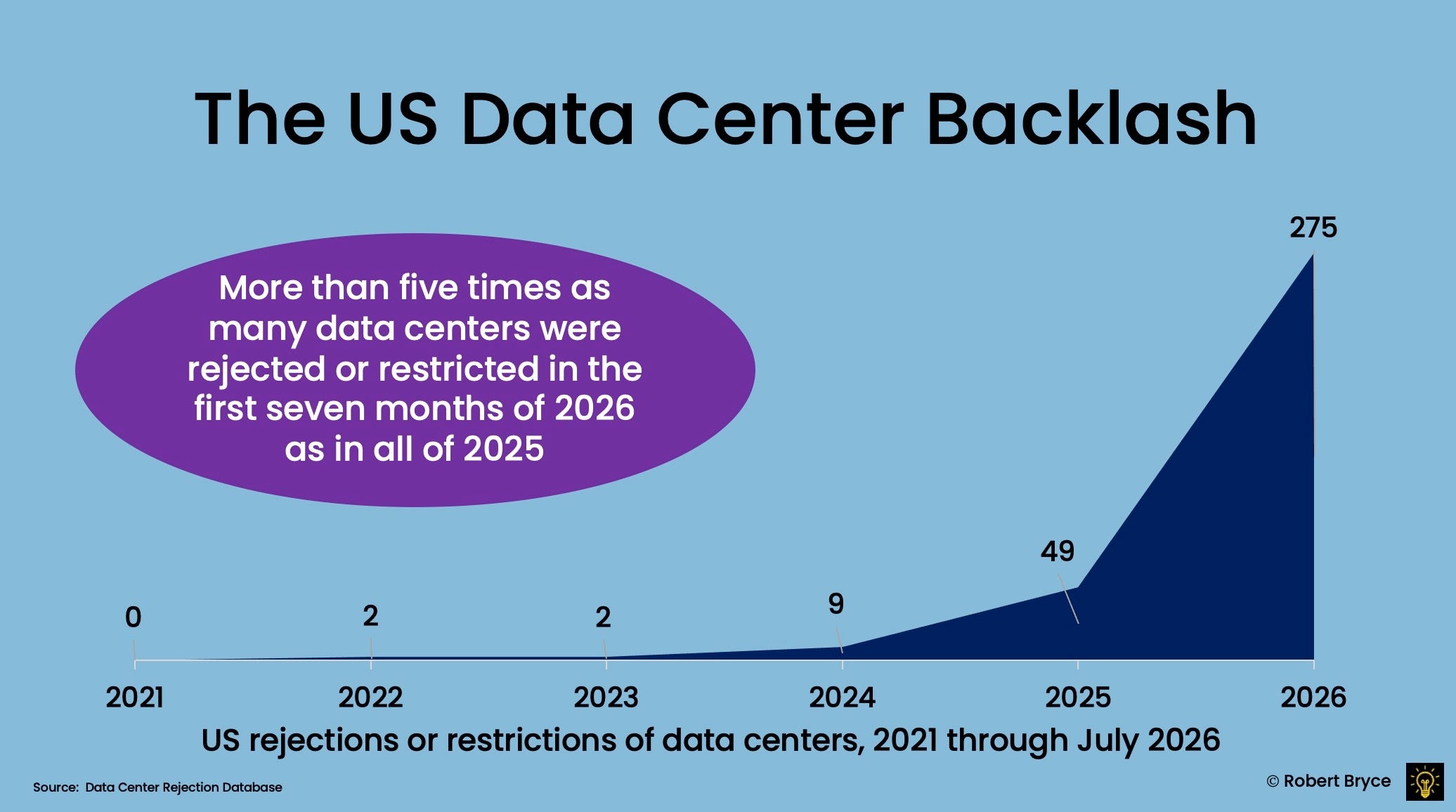
Over the past few weeks, Jacob and I have been combing through news articles and other outlets to make sure we have the latest figures. Here they are: Since January 1, 2026, we have documented 275 bans, rejections, restrictions, or moratoriums on data centers in the US. For comparison, there were 49 rejections in all of 2025. All of these rejections are documented in the Data Center Rejection Database, which is the only free, online, searchable database of its kind.
I’ll end by reiterating a few points. First, I have no dog in this fight. I have been reporting on data centers and power demand for more than 25 years. I’m continuing my coverage because the growth of data centers and AI involves many of the topics I’ve been focused on for years, including land-use conflicts, electricity demand, power generation, and the rise of Big Tech.
Second, I use AI nearly every day. It’s amazing.
Finally, here’s a prediction: Alexandria Ocasio-Cortez will run for president in 2028 and a key part of her platform will be opposition to data centers, Big Tech, and AI.
Before you go:
As always, you’ll do me a favor by clicking that ♡ button. Thanks.
UPDATE: I just posted a Note about this. And, frankly, I'm stunned by the news. TX Gov. Abbott has just slapped a freeze on new data center projects in the state. Wow. Wow. Wow.
https://www.texastribune.org/2026/08/03/texas-data-center-project-audit-greg-abbott/
I'm all for Nimbyism. People should decide what they have in their communities. Think Data Centers don't belong next to housing/neighborhoods. But, think some of this is overwrought. In Virginia, where there is a large collection of DCs, the county coffers apparently tripled. Not only the construction jobs, the permanent jobs, but the tax revenue is a strong collective good. Many places are seeing dramatic increases in tax revenue which can fund a lot of community goods and stop the growth in property/city/county taxes that is so problematic in many communities. Force the DC to provide their own power and used closed system water cooling. Don't give them tax breaks. Negotiate with them to build community goods.