Our Man in Caracas
Capturing Nicolás Maduro is only the latest example of US efforts at regime change in Venezuela. In 2002, the US supported a coup attempt against Hugo Chávez.
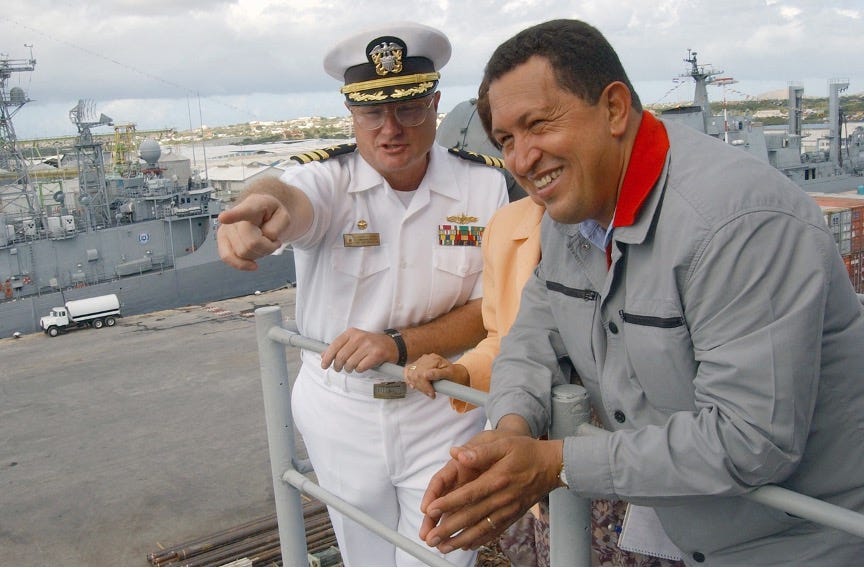
After four decades as a reporter, I spend a fair bit of my time repeating myself. In some ways, I reckon that’s a good thing. More than a decade ago, an author friend of mine who frequently writes about housing policy advised me, “Never write the same article once.”
That advice comes to mind because 19 years ago, I published an article about US support for an attempted coup against Hugo Chávez in 2002. I am reprinting it below.
It is relevant today for two reasons. First, it’s a compelling photo. The image makes it clear that Chávez wasn’t always considered an enemy of the US. If he had been, he wouldn’t have been aboard a US warship. Second, the legacy media’s coverage of the Maduro affair has often lacked historical context. The US didn’t suddenly decide that Venezuela matters. Venezuela has been in the US sphere of influence for more than a century. In 1913, John D. Rockefeller’s Standard Oil began drilling in the country. By the 1930s, three companies, Standard Oil, Gulf Oil (acquired by Chevron in 1984), and Royal Dutch Shell, controlled 98% of the Venezuelan oil sector.
Venezuela’s oil was on the minds of US leaders in 2002, and it remains a top agenda item today. I am publishing the entire 2007 article below. I have annotated the original article to provide context, correct an error, and give proper attribution. I also added links to the relevant news articles.