

Postcard From Saigon
A brief (free) note from Vietnam’s biggest city.
Construction cranes are everywhere in Saigon.
From our hotel room near the banks of the Saigon River, we could see more than two dozen of them. Construction is happening all over the town, which is properly known as Ho Chi Minh City.
Five decades after the US military left the country after an ignominious war, Vietnam has become an industrial powerhouse with one of the world’s fastest-growing economies. As one media outlet put it recently, Vietnam is “Transitioning from a developing frontier into a sophisticated, high-tech industrial giant.”

I wanted to visit Vietnam for many reasons. Among them: I wanted to see the place that’s making more and more of the stuff I buy. Last month, I bought a new laptop. It was made at a Foxconn factory northeast of Hanoi. A few days after the computer arrived, I went to Costco to get a few items and stopped to investigate the men’s clothing. Regardless of the brand, nearly all of it was from Vietnam. I went home and looked at my dress shirts. Vietnam. My spiffy new sneakers? Vietnam.
Yes, China is still the world’s biggest exporter of manufactured goods. But Vietnam is catching up, and fast. Last year, the country’s economy grew by 8%. That means its economy is doubling in size every nine years or so. And what’s fueling Vietnam’s ability to manufacture everything from laptops and semiconductors to shoes and shorts? Massive amounts of electricity — and that juice ain’t coming from solar panels and wind turbines.
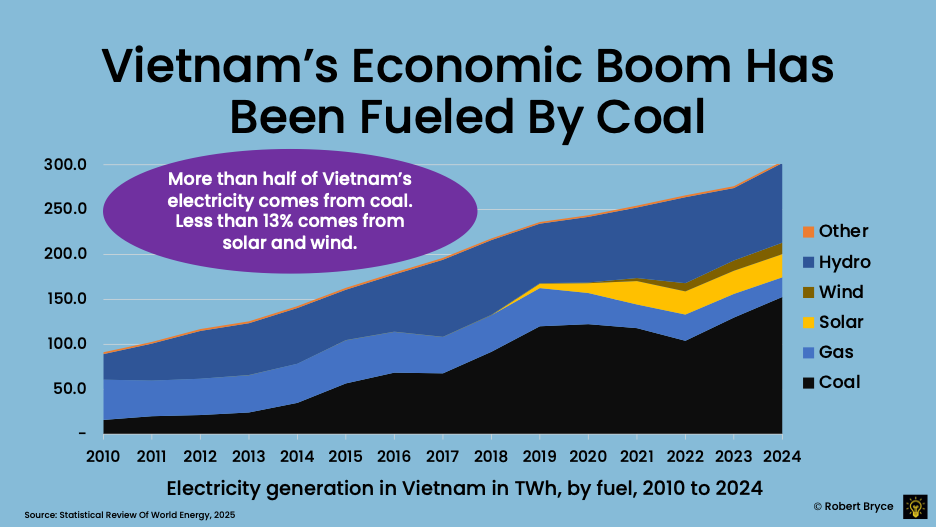
As seen above, more than half of Vietnam’s electricity is generated by coal-fired power plants. And Vietnam will be burning coal, and lots of it, for many years to come. Last year, the country set a new record for coal imports. In April, it inaugurated a new 1.3 gigawatt coal-fired power plant in north-central Vietnam. And according to Enerdata, over 6 GW of new coal plants are under construction, and another 3 GW of coal-fired capacity is in development.
I’ll be publishing more about Vietnam soon. We are heading to Singapore in the morning for some speaking engagements. (I’m talking about — what else? — booming electricity demand in Southeast Asia.) After that, I have another engagement in Kuala Lumpur.
I’m hoping this visit to Vietnam won’t be my last.
Before you go:
As always, please click that ♡ button. And, of course, please share and subscribe. Thanks, y’all.
It was bound to be. Lifting hundreds of millions out of abject poverty was always going to result in rising wages and higher living standards once China adopted State capitalism in the manner they did. While that wasn’t going to close the labor cost gap with the U.S. and Europe, it was going to open up a gap that SE Asia would exploit.
What happened to the U.S. industrial base will happen to China over time, for the same labor cost reasons.
Vietnam will burn the hell out of coal until they reach a certain living standard and per capita GDP.
Then they’ll have the wealth to care about air quality and burn less per unit of additional GDP.
Environmental Kuznets Curve, Robert.
Yeah, OK, fine … it doesn’t explain wealth disparity/inequity. But it is almost an iron law when it comes to the relationship between decreasing environmental degradation and increasing prosperity per unit of production over long periods of time.
EKC is at work in China now, and eventually in Vietnam, Indonesia, and elsewhere in SE Asia. Communism may slow down the progress, but won’t stop it.
Be sure the not to be missed Uncle Ho's body preserved in his mausoleum by the same people who maintains Lenin's body, or so I was told.