

The Enrichment Cycle, Again
More insider sales at Oklo. Plus, Deep Fission goes public, a chart of the pure-play SMR companies, and the four companies that just achieved criticality.
Of all the Enron executives, Lou Pai was one of the most arrogant and most flamboyant. Pai was also one of Jeff Skilling’s closest lieutenants. As I explained in my 2002 book, Pipe Dreams: Greed, Ego, And The Death of Enron, Pai had two passions in life: “Money and watching young women take their clothes off — but not necessarily in that order.”
Pai rose to the top at Enron because, as I wrote 24 years ago, he “had the intellectual firepower and focus needed to create the computer programs and systems that allowed Skilling to fulfill his vision of changing Enron into a quasi-investment bank.” And the more money Pai made for Enron, the more Pai was inclined to spend the company’s money. On one occasion in 1990, Pai submitted an expense report to the company that included a lunch at Rick’s, one of Houston’s most famous strip clubs. As one executive told me, the bill was “$757 for one lunch.”
Pai is also famous for his excellent timing. He left Enron in mid-2001, several months before the company collapsed in December 2001. That timing was fortuitous. He was never charged with any criminal wrongdoing at the company. But Pai didn’t leave empty-handed. In all, Pai sold $270 million of Enron stock, more than any other insider at the company. Enron CEO Ken Lay was the second-largest insider seller, with $184 million in sales.
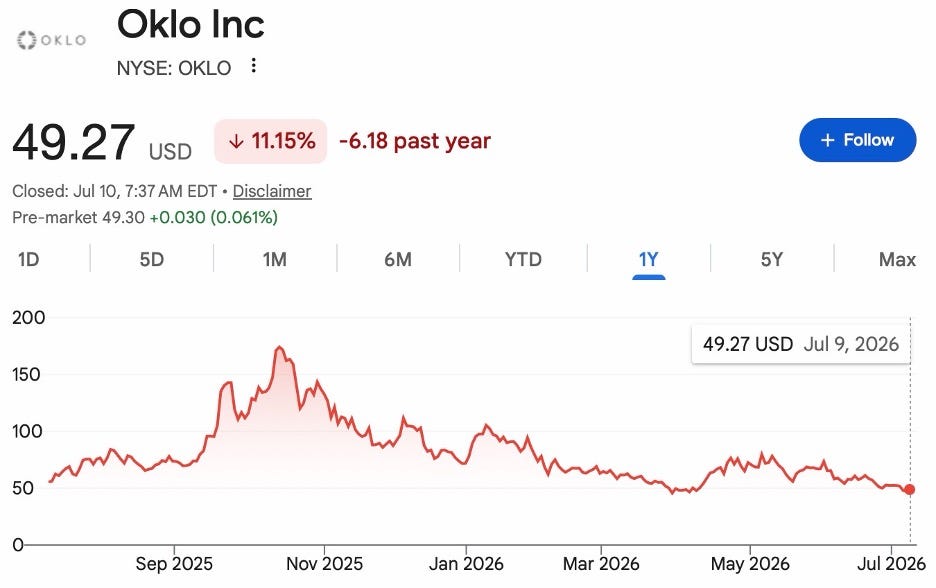
Those Enron numbers come to mind because of what is happening at Oklo Inc., the SMR company that went public in May 2024. As I wrote on March 10, in “Oklo’s Other Enrichment Cycle,” the company has been a darling of Silicon Valley and its co-founders, Caroline Cochran and Jacob DeWitte, are among the most prominent faces of the new generation of nuclear entrepreneurs. Cochran, a photogenic graduate of MIT, has appeared at numerous high-profile events, including the Aspen Ideas Festival. DeWitte was part of a contingent that visited the White House last summer for a photo op with President Trump.
While Oklo (market cap: $8.6 billion) has received a metric ton of positive media coverage, the company is trying to commercialize its advanced reactor design in a fiercely competitive market. Oklo is one of 42 US companies now seeking to commercialize a small modular reactor. Dozens of foreign companies are trying to do the same thing. On May 12, the company reported a first-quarter operating loss of $51 million. In the same report, the company noted it has recorded an accumulated deficit of nearly $274 million.
One key difference between Enron and Oklo, of course, is that Enron was a profitable business for decades. For instance, in 1999, two years before it collapsed in one of the biggest bankruptcies in US history, Enron’s revenues totaled $40 billion, and its net income was $957 million. Meanwhile, Oklo, which was formed in 2013, still has not recorded any revenue or profit. Despite Oklo’s ongoing losses, Cochran and DeWitte are continuing to sell significant chunks of their Oklo stock. In fact, their stock sales are leaving Lou Pai in the shade.
Here are the details on Oklo, plus two other SMR items: Deep Fission’s IPO and why the July 4 criticality hurdle matters.

Keep reading with a 7-day free trial
Subscribe to Robert Bryce to keep reading this post and get 7 days of free access to the full post archives.