

AI Rejected: Tracking The Great Data Center Revolt
The definitive, up-to-date list of the US communities that have rejected or restricted data centers in 2026.
For 16 years, I have been reporting on land-use fights over energy projects. Over that time, I have interviewed dozens of people from all over the world — including farmers, ranchers, politicians, and ordinary citizens — who are fighting against the encroachment of alt-energy projects. In all, I’ve documented nearly 1,200 rejections or restrictions of solar, wind, and battery projects.
But I’ve never seen anything like the raging backlash against data centers.
Since January 1, there have been more rejections or restrictions of data centers in the US than in all of 2025. Furthermore, the number of US data center rejections in 2026 is already nearly equal to the total number of wind projects rejected worldwide in 2025! And more rejections are coming. A recent poll found that 65% of Americans surveyed oppose data centers in their communities. (Details on that in a minute.)
My hometown of Tulsa is one of the communities that’s hitting the pause button. Last month, the Tulsa City Council voted unanimously to halt construction of new data centers for nine months. A total of 19 people spoke in favor of the moratorium during public comment, and one councilmember, Jackie Dutton, said she would support an indefinite moratorium due to concerns that data centers are being sited in the city’s underserved communities.
So what is happening? And why is it happening now?
The backlash against data centers looks a lot like the fights against Big Wind, Big Solar, and Big Battery. People are concerned about their neighborhoods, property values, viewsheds, and noise. But the opposition to data centers also includes two other hot-button issues: soaring electricity prices and water availability. And speaking of hot buttons, a new study claims that data centers can create heat islands that raise nearby temperatures by an average of 2 degrees Celsius (3.6 degrees F.)
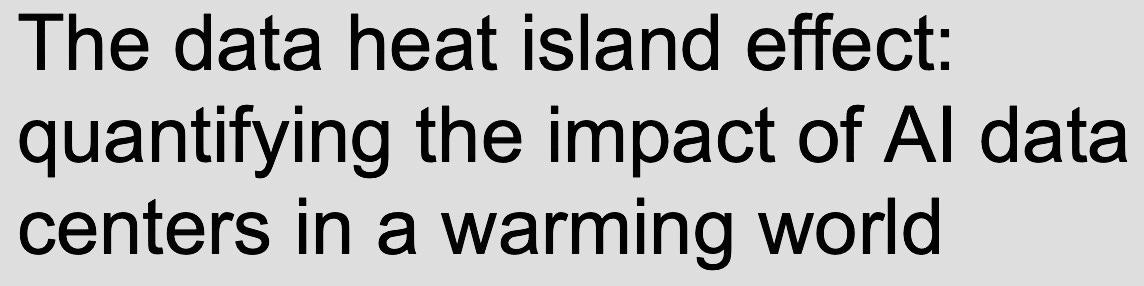
The study, which has a dozen authors and has not been peer-reviewed, found that data centers can induce:
Local microclimate zones, which we call the data heat island effect. We assess the impact on the communities, quantifying that more than 340 million people could be affected by this temperature increase. Our results show that the data heat island effect could have a remarkable influence on communities and regional welfare in the future, hence becoming part of the conversation around environmentally sustainable AI worldwide.
The findings make sense: Data centers produce huge amounts of heat, and it has to go somewhere. And the larger the data center, the more heat it produces. In addition, the study found that the heat island effect can extend for several kilometers around large data centers and that temperature impacts can be as much as 9.1 degrees C. (16.4 degrees F). (Ed Note: A few hours after I published this piece, I found Andy Masley’s March 30 Substack which says the heat island claim made by the study is “wildly misleading.” In light of Masley’s analysis, I made a few edits to my description of the report. I suggest you read his article. Again, here’s a link.)
Now add in distrust — or even outright hatred of Big Tech — and add in fears about AI destroying jobs, and you get a dream issue set for activists across the political spectrum. In short, this is a broad cultural backlash that cuts across political and demographic lines.
Jacob and I have painstakingly built an up-to-date compendium of every US data center rejection or restriction since January 1. We also pulled the key polling data, mapped the rejections, and created a graphic showing how opposition to data centers has exploded over the past three years.
Here are the details — and the receipts.

Keep reading with a 7-day free trial
Subscribe to Robert Bryce to keep reading this post and get 7 days of free access to the full post archives.